
· by Michael Blair, Nashville's Drywall Repair
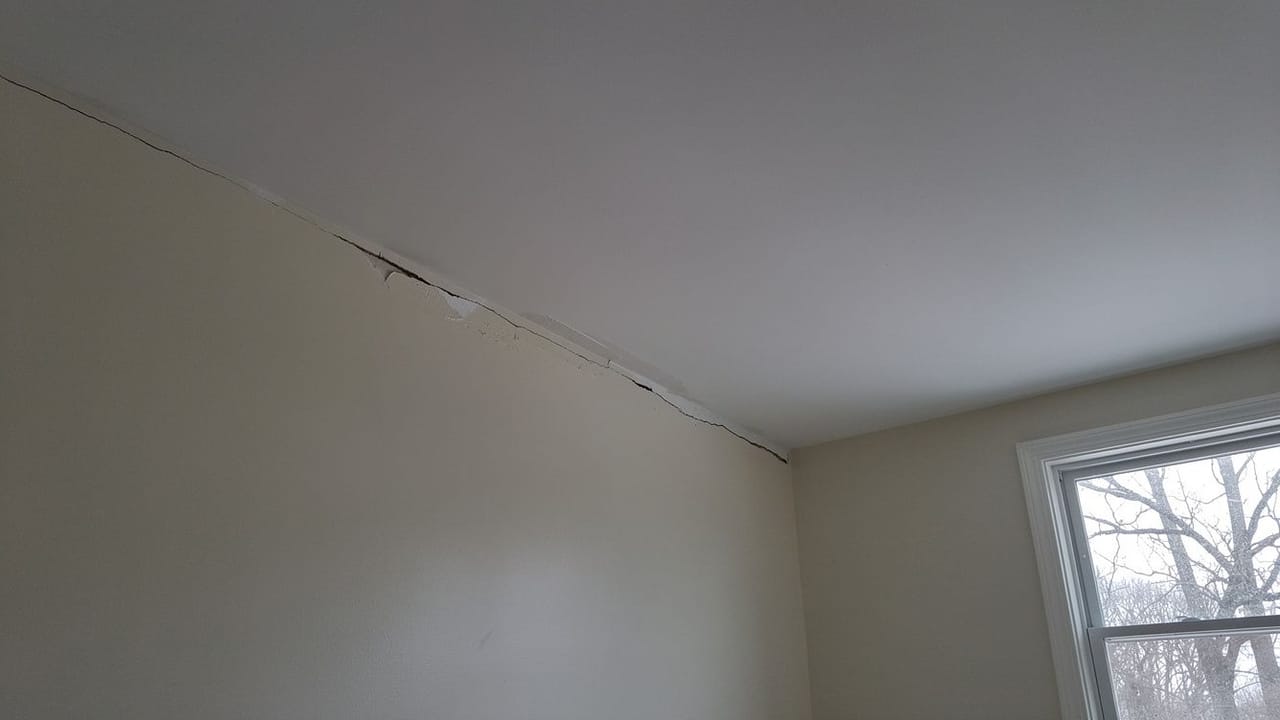
A gap that opens along the top of an interior wall in winter, in the corner where the wall meets the ceiling, and closes again by summer, is easy to misdiagnose. It gets blamed on settling, on the foundation, on whoever taped the joint. In a house with a trussed roof it is commonly truss uplift, a seasonal bowing of the roof trusses that lifts the ceiling off the interior walls. Canada’s National Research Council, in its digest on wood shrinkage in buildings, puts those cracks at up to 20 mm in severe cases, about three-quarters of an inch. It is not the only thing that opens that joint, though, and ruling out the others is the first part of any ceiling repair we take on.
What is moving
A roof truss is a triangle of lumber: two top chords that carry the roof and a bottom chord that carries the ceiling, with webs between them. In winter the top chords sit in ventilated attic air that holds about as much moisture as the air outside, so they take on moisture and lengthen. The bottom chord is buried in insulation and stays closer to the indoor temperature, and the air around it is drier, so it gives up moisture and shrinks. The Canada Mortgage and Housing Corporation’s builders’ guide to drywall application describes the same thing: a warmer, drier bottom chord shrinking more than the top one, and the truss bowing upward as a result.
The change in length is small. Wood barely shrinks along its length, 0.1 to 0.2 percent from green to oven-dry according to the USDA Forest Products Laboratory, but when the top of the triangle grows and the bottom shrinks, the peak is pushed up and the webs pull the middle of the bottom chord up with it. The ends stay put at the outside walls, and they have to: CMHC says trusses must be securely attached to exterior walls to prevent wind uplift on the roof. So the lift shows where the bottom chord crosses an interior wall. The ceiling drywall, screwed to the chord, goes up; the wall, standing on the floor, does not; and the corner joint tears.
How do you tell truss uplift from settling?
Uplift follows the seasons. CMHC’s guide says cracks where the ceiling meets the partition walls may open during the winter and close in the summer, and that the problem is generally worse during the first year after construction, while the house is drying out. It needs a trussed attic directly overhead, so we look for it on the top floor, in the corner where an interior wall meets the ceiling, running level along the joint. The NRC digest adds two things that make it worse: more insulation over the bottom chords, which widens the moisture difference between top and bottom, and a lower roof slope, which arches more for the same difference.
The catch is that other movement can crack the same corner. In Simpson Strong-Tie’s engineering post on truss movement, the author points out that it is not always the trusses that move; the walls or floors beneath them can, and the possible causes include foundation settlement, expansive soils, shrinkage of the framing and trusses pulled down to a partition during construction. CMHC also treats settlement and racking of the structure as a separate cause of cracks at wall and ceiling intersections. A crack that opens every winter and closes every summer points at the trusses. One that never closes is the one we look at harder before anybody patches it. Cracks along the tape seams out in the middle of the ceiling are a different problem, covered in our post on nail pops and cracked seams.
- Opens in winter, closes in summer: points to uplift
- Level, in the corner where an interior wall meets the ceiling
- On the top floor, with a trussed attic above
- Often worst in the first year after the house was built
- Never closes, or arrives with other cracks: look further before patching
Why does filling an uplift crack fail?
The joint is going to move again next winter. Compound, tape, caulk and paint all sit on the joint, and none of them stop the truss from lifting, so a filled crack tears open along the same line. The NRC digest is blunt about it: where floating corners were not built in, corrective action is normally limited to concealing the damage with moldings or suspended ceilings.
Fastening the trusses tighter to the wall does not stop it either. CMHC warns that fastening trusses more securely to the partition walls may actually lift the walls off the floor, and that driving wedges between the trusses and the partitions can cause serious structural problems when the truss settles later.
How is a truss uplift crack hidden?
The accepted fix is to let the ceiling float at the wall. The ceiling drywall is left unfastened to the trusses for a set distance on each side of the interior wall and is held at the wall by clips or blocking on the top plate, so when the truss lifts, the ceiling stays down at the wall and flexes over the unfastened span. CMHC gives minimum float distances of 12 inches for half-inch ceiling board and 16 inches for five-eighths, keeps the wall board’s fasteners 8 inches below the corner, doubles the first row of fasteners and notes that gypsum manufacturers advise against floating the ceiling more than 24 inches. Built that way, a floating corner can take 2 to 3 inches of uplift without cracking, by CMHC’s figures. In a finished house, the same guide’s remedy is to drive the ceiling fasteners near the corner through and retape the joint, which turns it into a floating corner. That is how we handle it as drywall repair: release the screws nearest the wall, retape and refinish the corner, then blend the ceiling around it.
Where that is not practical, a molding attached to the ceiling only, not to the wall, covers the joint and slides against the wall as it moves. CMHC’s drawing of this slip joint shows the trim nailed to the truss only and the drywall painted before the trim goes on, and the NRC digest describes the molding sliding up and down the wall with the seasonal movement of the trusses. It also suggests sealing the crack with adhesive tape first if the vapor barrier was torn, to keep house air from leaking into the attic. The gap keeps opening and closing behind the trim, where nobody sees it. If you are not sure which of the two suits the room, book a free estimate and we will tell you what we would do.
Sources
- Canada Mortgage and Housing Corporation, Drywall Application, Builders’ Series (revised 1990, reprinted 1994) — Bottom chord warmer and drier, truss bows up; opens in winter, closes in summer; worse in the first year; trusses fastened to exterior walls; no tighter fastening or wedges; float distances 12, 16 and 8 inches, double fasteners, no more than 24 inches; 2 to 3 inches of uplift; drive fasteners through and retape; slip-joint molding nailed to the truss only
- National Research Council Canada, CBD-244 Effects of Wood Shrinkage in Buildings (1987) — Cracks up to 20 mm in severe cases; top chords lengthen, lower chords shrink; more insulation and lower slope increase arching; molding fastened to the ceiling supports slides with the trusses; concealing is the remedy without floating corners; seal with tape
- Simpson Strong-Tie SE Blog, Accommodating Truss Movement (Besides Vertical Deflection) (2015) — Not always the trusses that move; settlement, expansive soils, framing shrinkage and construction errors; truss arching is not a structural problem
- USDA Forest Service, Forest Products Laboratory, Frequently Asked Questions — Longitudinal shrinkage of 0.1% to 0.2% from green to oven-dry
FAQ
Truss Uplift and the Ceiling Crack That Comes Back — questions
Why does the crack between my ceiling and wall open every winter?
Most often because the roof trusses lift in winter. The top chords in the attic take on moisture and lengthen while the bottom chord, buried in insulation, dries out and shrinks, so the truss bows upward and lifts the ceiling off the interior walls. It usually closes again in summer. Wall or floor movement and foundation settlement can crack the same corner, so a crack that never closes deserves a closer look.
Is truss uplift a structural problem?
No. Arching that comes from the natural shrinking and swelling of wood does not indicate a structural problem, as Simpson Strong-Tie’s engineers put it. It is a cosmetic problem at the ceiling-to-wall joint. The fixes to avoid are the forceful ones: wedging the trusses or fastening them tighter to interior walls can cause real damage, and the trusses must stay securely attached to the outside walls.
How do I fix a ceiling crack from truss uplift?
Either release the ceiling drywall from the trusses near the wall, at least 12 inches for half-inch board and 16 inches for five-eighths, and retape the corner so the ceiling can flex, or fit a molding fastened to the ceiling only so it slides over the wall as the joint moves. Filling and painting the crack will not hold.
Can truss uplift be stopped?
Not by force. CMHC warns that fastening trusses tighter to interior walls can lift the walls off the floor, and that wedges between trusses and partitions can cause serious structural problems later. The movement comes from wood taking on and losing moisture, so the repairs work around it with a floating ceiling corner or a ceiling-only molding.