
· by Michael Blair, Nashville's Drywall Repair
Soundproofing a wall between two rooms tends to disappoint, because the obvious fix goes after the wrong path. In an ordinary wall the same studs hold the drywall on both sides, so sound crosses mostly by shaking the structure, and the Steel Framing Industry Association’s summary of National Research Council of Canada research says sound-absorbing material in the cavity becomes ineffective when the two faces aren’t isolated from each other.
What actually reduces sound through a wall?
Mass, because a heavier assembly is harder to vibrate. Decoupling, which breaks the physical path so vibration can’t pass straight from one face to the other. Absorption, which is what insulation in the cavity does. And damping, a viscoelastic layer that turns vibration into heat. National Gypsum’s article on the variables that affect STC ratings works through the same four.
Insulation is the obvious one, and how much it does depends on the wall. Owens Corning’s guide to sound and fire rated assemblies puts the gain at about 8 dB in a metal stud wall, a staggered wood stud wall or any other wall whose faces are isolated, and calls that readily noticeable. In a plain wood stud wall the studs still tie both faces together, so the same insulation is much less effective, which is why blowing it into a finished wall and stopping there tends to change little.
What is the best retrofit for a finished wall?
What we usually suggest for a finished wall is a second layer on one face: either a factory-damped acoustic panel, or standard drywall laminated over the old board with a damping compound between the two. Either way it adds mass and damping together and goes on over the existing wall, so the cavity stays closed. Mass alone does less than you might hope. In Pliteq’s ASTM E90 tests, published in Canadian Acoustics, doubling plain drywall on both sides of a single stud wall moved it from STC 37 to 41. For scale, the NRC’s study of electrical boxes in stud walls treats a one-point STC difference as insignificant and three or more as a clear one. The damping is what earns the layer its place: National Gypsum’s webinar answers on acoustically enhanced board call its damped panel very effective on one side of a wall, and in the company’s own STC example, swapping one layer for that panel raises a wall by 11 points.
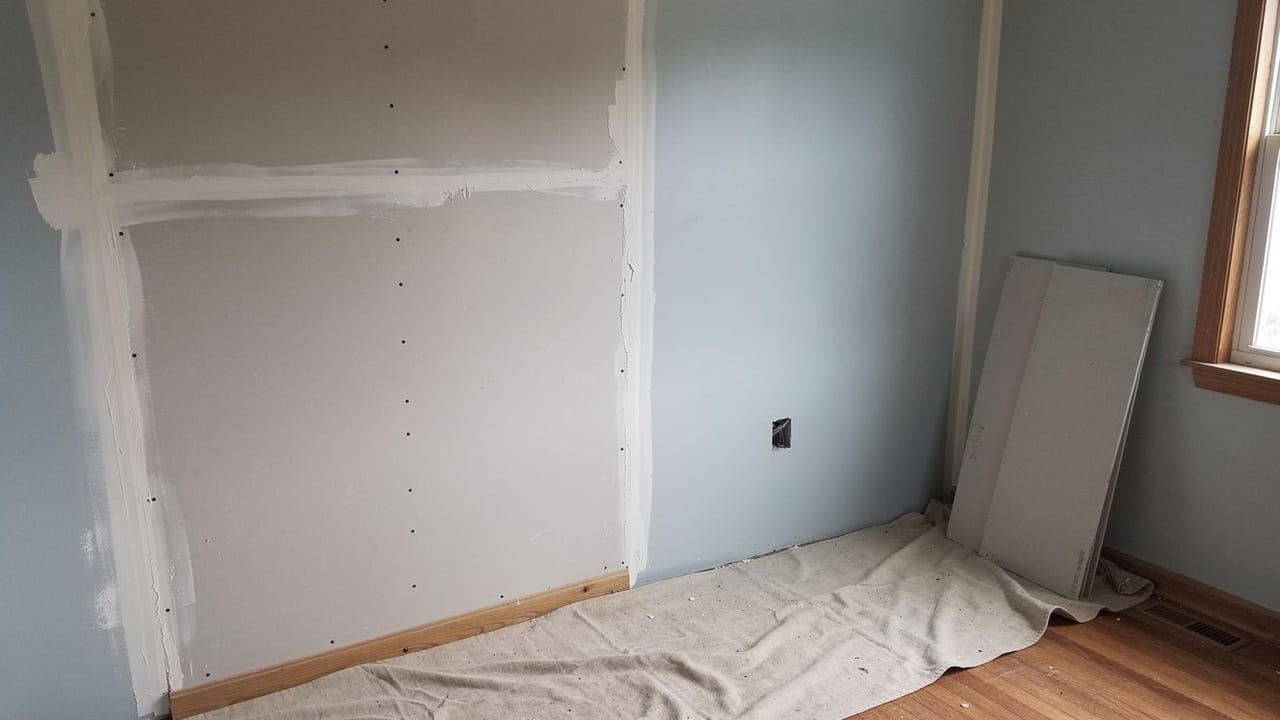
One added layer costs about half to five-eighths of an inch of room, the two board thicknesses used in the NRC’s tests of roughly 400 gypsum board walls. On that side the outlets need box extenders, and the trim and the door casing come off and go back. It’s the same hanging, taping and finishing as new drywall installation, and far less disruption than gutting the wall.
If that face is coming off to the studs anyway, decoupling beats mass. In the same Pliteq tests, a single stud wall with one layer each side rated STC 37, rose to 50 on resilient channel and reached 57 on isolation clips. Channel has one catch: a screw that misses the channel and bites a stud short-circuits it, and the paper reports up to a 10-point loss from that.
- Damped second layer on one face: our first choice for a finished wall
- Resilient channel or sound clips: a bigger gain, with new board hung over them
- Cavity insulation: little alone in a plain stud wall, about 8 dB once the faces are isolated
- Seal every gap, outlet and penetration first
- Door: solid core, gasketed at the top and sides, with a sweep or threshold closure
The leaks that undo everything
Sound behaves like water in that it finds the smallest opening. Back-to-back outlets in the same stud cavity open a direct path through the wall. In the NRC box study, standard metal boxes placed back to back took a double stud wall from STC 55 to 51, poorly located boxes cost up to 6 points, and airtight plastic boxes cost nothing measurable; insulation laid over the backs of the boxes reduced the loss very effectively. Owens Corning’s guide says switches and outlets shouldn’t be built back to back, and names the other leaks: the top and bottom plates, the gaps around a door, and ducts, which carry sound easily from room to room.
Sealing is small work, and we do it first rather than last. Owens Corning recommends a non-hardening, permanently resilient caulk, such as a butyl rubber compound, on both sides of the wall, and National Gypsum warns that some sealants harden and can compromise the rating. Putty pads behind outlet boxes, a door sweep and a solid core door gasketed at the top and sides close the rest. On a wall that is otherwise sound, sealing wins back the few points the openings were costing; rated walls are tested without penetrations, as National Gypsum points out, so an unsealed wall won’t match its lab number. When a wall has to be opened to reach the backs of the boxes, closing it again is ordinary drywall repair, the same work as closing the hole a plumber or electrician left.
How quiet can a retrofit make a room?
A retrofit can make the next room noticeably quieter. Bass from a drum kit or a home theater is the hard part. The NRC’s gypsum board study found wall ratings are usually controlled by what happens below 500 Hz, where mass, cavity depth and stud spacing do the work, and in Pliteq’s tests the double stud wall gave the highest transmission loss at low frequencies.
It helps to be clear about the goal. Taking the edge off a television or a conversation next door is what sealing and a damped layer are for. A room isolated for music production or a home cinema is a construction project rather than a drywall one: in Pliteq’s tests only the double stud walls (STC 61 to 65) and the clip-mounted walls (57 to 64) reached the top of the range. If you’d like us to look at the wall and tell you which side to work from, ask for a free estimate.
Sources
- Steel Framing Industry Association, Control of Sound Transmission through Gypsum Board Walls (summary of NRC Canada research) — Cavity absorption is ineffective when the two faces are not isolated; isolated faces gain from mass, cavity depth and absorption
- National Gypsum, 6 variables that affect STC ratings (2023) — Mass, decoupling, absorption and damping; damping dissipates sound as heat; 11-point example for a damped panel; fiberglass and mineral wool beat spray foam
- Owens Corning, Wall & Floor Assembly Guide: Insulation for Sound & Fire Rated Assemblies — About 8 dB from insulation in walls with isolated faces; no back-to-back outlets; seal plates and ducts; non-hardening butyl caulk; solid core gasketed doors and threshold closures
- W. Byrick (Pliteq), Examining Airborne Sound Transmission Loss in Various Wall Constructions, Canadian Acoustics 39(3), 2011 — ASTM E90 results: single stud STC 37, doubled drywall 41, resilient channel 50, clips 57, double stud highest; short-circuited channel loses up to 10 points
- T.R.T. Nightingale and J.D. Quirt, NRC Canada, Degradation of Wood Stud Wall Sound Isolation by Electrical Boxes, Canadian Acoustics 23(3), 1995 — Back-to-back metal boxes STC 55 to 51, up to 6 points lost, airtight boxes no loss; absorption over box backs helps; significance of 1 and 3 STC points
- A.C.C. Warnock and J.D. Quirt, NRC Canada, Sound Transmission Through Gypsum Board Walls, Canadian Acoustics 23(3), 1995 — Half-inch and five-eighths board in about 400 tested walls; ratings controlled below 500 Hz by mass, cavity depth and stud spacing
- National Gypsum, Acoustically enhanced gypsum board webinar Q&A — Damped panel very effective on one side of a wall; walls tested without penetrations; some sealants harden and compromise the rating
FAQ
Soundproofing an Interior Wall That Is Already Built — questions
Does insulation in a wall stop sound?
It helps, and how much depends on the wall. In an ordinary wall where the same studs carry drywall on both sides, the studs pass vibration straight across and the insulation is much less effective. Once the faces are isolated, with clips, resilient channel or separate studs, cavity insulation adds a noticeable gain, and fiberglass or mineral wool does more than spray foam. Combined with added mass or decoupling it contributes usefully; on its own in a plain stud wall it disappoints.
Is there a soundproof paint that works?
We have not seen test data showing a paint-thickness coating making a meaningful difference to a wall’s sound rating. The published wall tests point to the same four levers, mass, decoupling, absorption and damping, and a coat of paint adds very little weight next to a sheet of drywall.
What is the cheapest thing that actually helps?
Sealing the leaks, which is small work next to adding a layer or opening the wall. Putty pads behind back-to-back outlet boxes, a non-hardening sealant at the wall perimeter and a door sweep close direct openings through the assembly. Do them first: rated walls are tested without penetrations, so open boxes and gaps eat into whatever larger work comes afterward.
How do soundproof walls work?
With four levers: mass that is harder to vibrate, decoupling that breaks the path from one face to the other, absorption from insulation in the cavity, and damping that turns vibration into heat. Rated walls combine them and are tested without penetrations, so gaps and back-to-back outlets cut into what a real wall delivers.