
· by Michael Blair, Nashville's Drywall Repair
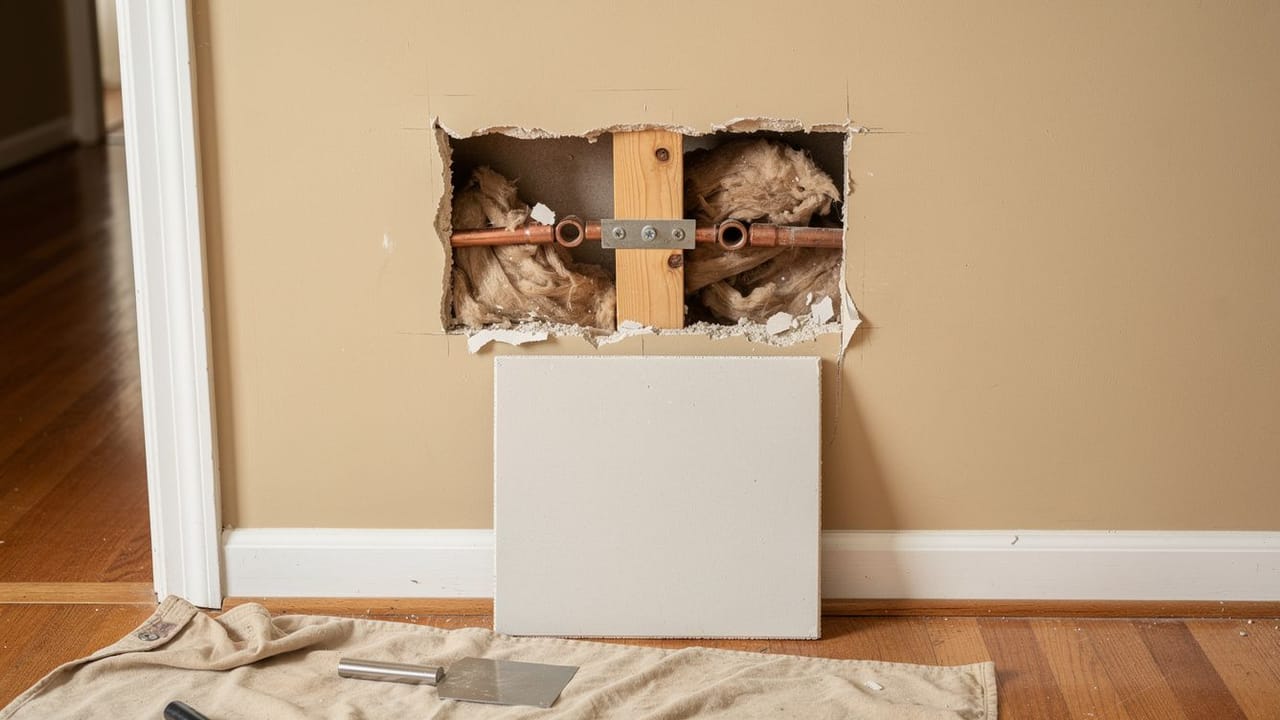
Plumbers and electricians open walls because that is where the work is, and in our experience most of them leave the wall open when they go. The estimate often says so in one line near the bottom. The homeowner ends up with a hole that was cut to reach something rather than to be patched, often with a torn paper face, a cut stud edge and sometimes a second hole next to the first where the first guess was wrong. Closing it is drywall repair like any other, but doing it well starts with a few questions that have nothing to do with drywall.
What has to happen before the wall is closed?
If the job added or moved wiring, the inspector has to see it before the wall is covered. Tennessee’s rules are blunt about it: the State Fire Marshal’s electrical installation rules, chapter 0780-02-01, require the inspection before wiring is concealed by wall covering or insulation and say no wiring may be concealed until the inspector has approved it. For a plumbing or gas permit, ask the codes office which inspections it calls for before anything is closed. Inside Davidson County that office is Metro Codes, whose page on requesting an inspection gives separate lines for electrical, plumbing and gas work, and Metro’s 2024 code adoption applies to all building and trades work permitted in the county. Elsewhere it is the city or county office, and where no local government enforces its own code, the state’s residential permit FAQ says the State Fire Marshal’s Office does.
Closing a wall on uninspected work can mean opening it again, so we ask whether the inspection has passed before a board goes back.
For a leak, the cavity has to be dry, and drying should start the day the leak is found. Wet insulation, a damp bottom plate or a stain still spreading on the framing all need air moving through them. The EPA’s brief guide to mold, moisture and your home says that when damp materials are dried within 24 to 48 hours of a leak, mold will not grow in most cases. A cavity that stayed wet longer than that gets looked at for mold before it is closed, because board screwed over a damp cavity gives mold a dark place to start where nobody sees it until it stains through the paint. When the water reached well past the cut opening, it is a water-damaged drywall job rather than a patch.
Should the opening get a patch or an access panel?
Some holes should not be patched shut, and a junction box is the clearest case. Metro’s adopted codes list includes the 2023 National Electrical Code, and section 314.29 of that code, in the wording of NFPA’s 2023 interim amendment to it, requires a box recessed behind a finished surface to keep its contents reachable through openings in its cover and in the wall, with removable covers and faceplates allowed. A drywall patch over a box does not meet that.
A shower valve with cartridges that will need replacing, a cleanout on a drain line, or a spot where the same pipe has leaked before is, in our judgment, better served by a removable panel too. A plain white panel on the back of a closet wall usually costs less than cutting the same hole again later. Where the opening faces a living room or a hallway, we frame the panel flush and paint it with the wall so it does not draw the eye. Where nothing behind it will ever need a hand again, patch it.
- Shower and tub valves: panel from the room behind
- Drain cleanouts: panel
- Junction boxes: must stay accessible, so a panel or a cover plate
- A pipe that has leaked there before: panel
- A wire run that is finished and inspected: patch
How is a ragged trade hole repaired?
The first job is to square it. A trade hole has torn paper, crushed gypsum and edges that wander, and a patch fitted to that shape tends to fail along those edges. We cut back to clean lines, and to the center of a stud on one side when one is close, so the new piece has something solid at its edges.
Where there is no framing, wood backing goes across the opening, screwed through the old board from the front. The new piece is cut to fit with a small gap, screwed off, taped and finished in thin coats, with the compound carried well past the cut; USG’s white paper on finished wallboard appearance calls compound applied in graduated arcs over the joints the best method to minimize how they show.
Before driving a screw near a notched or bored stud, look for a steel plate over any pipe that runs close to its face. The residential code’s plumbing rule, in the text South Carolina’s regulations reproduce from the IRC, calls for steel shield plates where a pipe other than cast iron or galvanized steel passes through a stud less than 1 1/4 inches from its nearest edge. A screw driven into a pipe that sits close to the face is how a patch causes a new leak.
Matching what surrounds it
A patch in a textured wall has to be textured to match, and our post on matching wall texture on a repair covers how that is done. One in a smooth wall under a window needs the joints feathered wide enough that raking light does not pick out the square. The same USG paper notes that, depending on the light and the paint, shadows at the joints may show even when the most skilled finishers did the work, and it points to a skim coat where side lighting is severe.
Either way the patch gets primed before paint. USG says priming is done before texturing or finish painting, and it describes a skim coat as equalizing the suction difference between the face paper and the joint compound, which is why new compound takes paint differently from the old painted wall around it.
The paint is the part people underestimate. In our experience, touching up a patch with the leftover can from the garage rarely matches a wall that has aged for years, and USG lists paint quality, sheen and color among what decides how a finished wall looks. Painting the whole wall, corner to corner, is often what makes the repair disappear, and it is worth deciding before the patch is done rather than after. If you want that in the scope from the start, ask us for a free estimate.
Sources
- Tennessee Division of Fire Prevention, Rules ch. 0780-02-01 Electrical Installations (copy hosted by UT MTAS, 2019) — Rule 0780-02-01-.04: wiring inspected before it is concealed by wall covering or insulation; no wiring concealed until approved
- Metro Nashville Codes, Requesting an Inspection — Metro Codes inspection lines for electrical, plumbing and gas work in Davidson County
- Metro Nashville Codes, Metro Adopts 2024 International Building Codes — The 2024 codes apply to all building and trades work permitted in Davidson County
- Tennessee Department of Commerce and Insurance, Residential Permit FAQs — The State Fire Marshal’s Office enforces where a local government does not enforce its own code
- U.S. EPA, A Brief Guide to Mold, Moisture, and Your Home — Materials dried within 24 to 48 hours of a leak will not grow mold in most cases
- Metro Nashville Codes, Adopted Codes List — Metro has adopted the 2023 National Electrical Code
- NFPA, Tentative Interim Amendment 23-10 to NFPA 70 (2023), section 314.29(A) (copy hosted by NYC Department of Buildings) — Boxes behind finished surfaces keep their contents accessible; removable covers and faceplates permitted
- South Carolina Code of Regulations 8-1240 (reproduction of IRC P2603.2.1, via Cornell LII) — Steel shield plates where pipe other than cast iron or galvanized steel is less than 1 1/4 inches from the edge of a stud
- USG, Wallboard Finished Appearance: Managing Expectations and Best Practices (WB2625) — Graduated arcs of compound minimize joints; light and paint decide whether joints show; skim coat for side lighting; prime before painting; suction difference between face paper and compound
FAQ
Closing the Hole a Plumber or Electrician Left — questions
Does a plumber fix the drywall they cut?
Usually not, in our experience. Many plumbing and electrical estimates leave out drywall repair and paint, and the ones that do often say so in the fine print. Check the estimate before the work starts so the patch is planned for rather than a surprise.
How long should I wait to close a wall after a leak?
Until the framing and insulation in the cavity are dry, and drying should start right away. The EPA says damp materials dried within 24 to 48 hours of a leak will not grow mold in most cases. A cavity that stayed wet longer than that should be checked for mold before it is closed, since closing it damp gives mold a place to grow behind the new board.
Should I put an access panel behind my shower?
If the wall behind the valve is a closet or other hidden spot, we would. Cartridges and valve bodies can need service over the years, and a panel means the next repair does not start with cutting drywall.
How do you patch a large hole with no stud behind it?
With wood backing screwed across the opening through the old board from the front. We square the hole first, cutting to the center of a stud where one is close, then fit the new piece with a small gap, screw it off, tape it and finish it in thin coats carried well past the cut.