
· by Michael Blair, Nashville's Drywall Repair
We still come across popcorn ceilings in the bedrooms and hallways of older Nashville houses, and some of that texture contains asbestos. The EPA counts textured paint and patching compounds used on walls and ceilings among the household products that may contain it. So before any popcorn ceiling removal gets as far as blades and buckets, we want to know what is in the ceiling.
Should popcorn texture be tested before removal?
Yes, because looking at it will not tell you. If you plan a renovation that would disturb a suspect material, the EPA’s guidance on asbestos in remodeling recommends having it sampled by a trained and accredited asbestos inspector, who should then use a qualified laboratory for the analysis. Its advice to families adds that taking samples yourself is not recommended, and that when in doubt you treat the material as if it contains asbestos and leave it alone.
The age of the house narrows the question without answering it. EPA’s record of federal asbestos bans shows spray-applied surfacing material banned for fireproofing and insulation in 1973 and for other purposes in 1978, and asbestos in wall patching compounds banned by the Consumer Product Safety Commission in 1977. None of those entries names popcorn texture, so we don’t treat a build date as a clean bill. Any old texture of unknown makeup gets sampled before we touch it.
Texture that stays where it is behaves differently from texture coming down. In general, the EPA says, exposure may occur only when asbestos-containing material is disturbed or damaged, and its list of don’ts for homeowners starts with don’t saw, sand, scrape, or drill holes in it. Scraping is the entire removal method, which is why the lab result has to be back before a blade goes up.
A positive result changes who does the work. The EPA describes removal as complex and says it must be done only by a trained and accredited asbestos professional. The same page notes that federal law does not require that accreditation for work in a detached single-family home, though some states and localities do. Tennessee’s rule, as TDEC’s asbestos program page describes it, requires accredited people for asbestos work in schools and in public and commercial buildings, and the federal asbestos rule’s definition of a facility leaves out residential buildings with four or fewer dwelling units. We don’t scrape a ceiling that has tested positive. For a rental, a multi-unit building or anything commercial in Davidson County, we put the question to Metro Public Health’s Air Pollution Control division before work is planned.
What does removal involve once the test is negative?
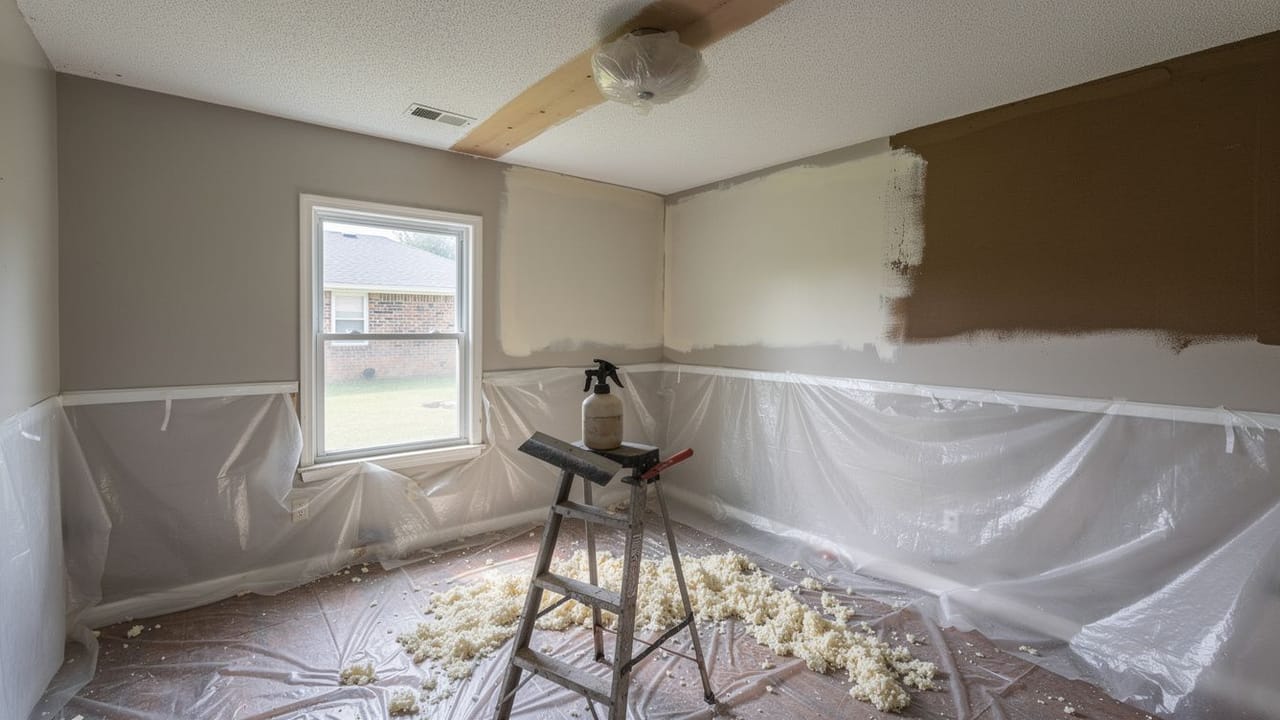
With a negative result in hand, the job is messy more than it is technical. We clear the room, sheet the floor and walls in plastic, wrap the light fixture and cover the vents, then mist the ceiling with water to soften the texture and scrape it with a wide blade.
How the misting is done decides most of what follows. Wet only the surface and the texture comes off in dry crumbs and dust; give the water time to soak through and it lets go far more easily, so we work one section at a time and come back to it once it has softened.
- Have an accredited inspector sample it before any scraping
- If it tests positive, leave it alone and bring in an accredited asbestos professional
- Mist thoroughly and let it soak before scraping
- Expect to skim and sand afterward
- Painted texture takes us much longer to get off
What comes after scraping
The ceiling underneath is rarely ready for paint. Plan on a skim coat, sanding and primer, and possibly re-taping seams that were never finished properly because texture was going to cover them. All that sanding is one more reason the test comes first, since sanding sits right beside scraping on the EPA’s list of things not to do to asbestos-containing material.
In our experience that second stage is the larger part of the job, and it is the part people underestimate. How flat the ceiling should end up is a question of finish level, which our post on drywall finish levels explains, and a ceiling headed for a truly smooth surface is covered in our post on refinishing a ceiling smooth.
Painted texture
Once texture has been painted, the paint keeps the water from soaking in, and in our experience it scrapes far less willingly. Removal gets considerably harder, and sometimes covering the ceiling is the better answer.
Hanging thin drywall over the existing ceiling is a legitimate option, and it is the one we look at when texture has tested positive. The EPA counts covering, which it calls enclosure, as a kind of repair in which the asbestos stays in place, and it treats repair of material that could be disturbed as work for trained and accredited professionals. New board is held up with screws driven through the old texture, and drilling holes is on that same don’t list, so on a positive ceiling we ask an accredited asbestos professional how the enclosure should be done before we hang anything. If you are not sure which of these you have overhead, ask us for a free estimate and we will look at it with you.
Sources
- U.S. EPA, Learn About Asbestos — Textured paint and patching compounds on walls and ceilings may contain asbestos; exposure generally occurs only when the material is disturbed or damaged
- U.S. EPA, I’m remodeling my home. Do I need to be concerned about asbestos in the building materials? — Sampling by a trained, accredited inspector before a disturbing renovation; analysis by a qualified laboratory
- U.S. EPA, Protect Your Family from Exposures to Asbestos — Do not sample yourself; when in doubt leave it alone; do not saw, sand, scrape or drill; removal only by accredited professionals; covering (enclosure) as repair; no federal accreditation rule for single-family homes
- U.S. EPA, U.S. Federal Bans on Asbestos — Spray-applied surfacing bans of 1973 and 1978; CPSC ban on asbestos in wall patching compounds, 1977
- Tennessee Department of Environment and Conservation, Asbestos Program — Rule 0400-13-02: accredited persons only for asbestos activities in schools and public and commercial buildings
- eCFR, 40 CFR 61.141, Asbestos NESHAP definitions — Federal definition of a facility excludes residential buildings with four or fewer dwelling units
- Metro Nashville Public Health Department, Air Pollution Control — Local air pollution control contact for Davidson County
FAQ
Removing a Popcorn Ceiling the Right Way — questions
Does my popcorn ceiling contain asbestos?
It might, and you cannot tell by looking. The EPA lists textured paint and patching compounds on ceilings among the products that may contain asbestos, and before a renovation that would disturb it, the agency recommends that a trained, accredited inspector take the sample and a qualified laboratory analyze it. Texture in good condition that nobody disturbs can be left alone, by the EPA’s guidance; scraping, sanding or drilling it is what releases fibers.
Can I remove popcorn ceiling myself?
Only once a sample has come back negative. Then it is a messy job more than a technical one: sheet the room, mist the texture and let the water soak in, and scrape with a wide blade. What people underestimate is the finishing afterward, since skimming, sanding and priming usually take longer than the scraping. If the sample is positive, the EPA says removal should be done only by a trained and accredited asbestos professional.
What if the texture has been painted?
Paint keeps the water from soaking in, so removal gets considerably harder in our experience. Covering the ceiling with thin drywall is a reasonable alternative. If the texture has tested positive, the EPA treats covering as a repair that leaves the asbestos in place, and the screws holding the new board go through the old texture, so we ask an accredited asbestos professional how it should be done before any work starts.
How do you finish a ceiling after removing popcorn?
With a skim coat, sanding and primer, and sometimes re-taping seams that were never finished properly because texture was meant to cover them. In our experience that second stage is the larger part of the job, and the one people underestimate. How flat the ceiling should end up is a question of finish level.