
· by Michael Blair, Nashville's Drywall Repair
Different boards suit different exposures, and the mix-up worth avoiding is treating moisture-resistant drywall as a waterproof product. It is not, and the residential code does not allow it where water hits it directly.
The options
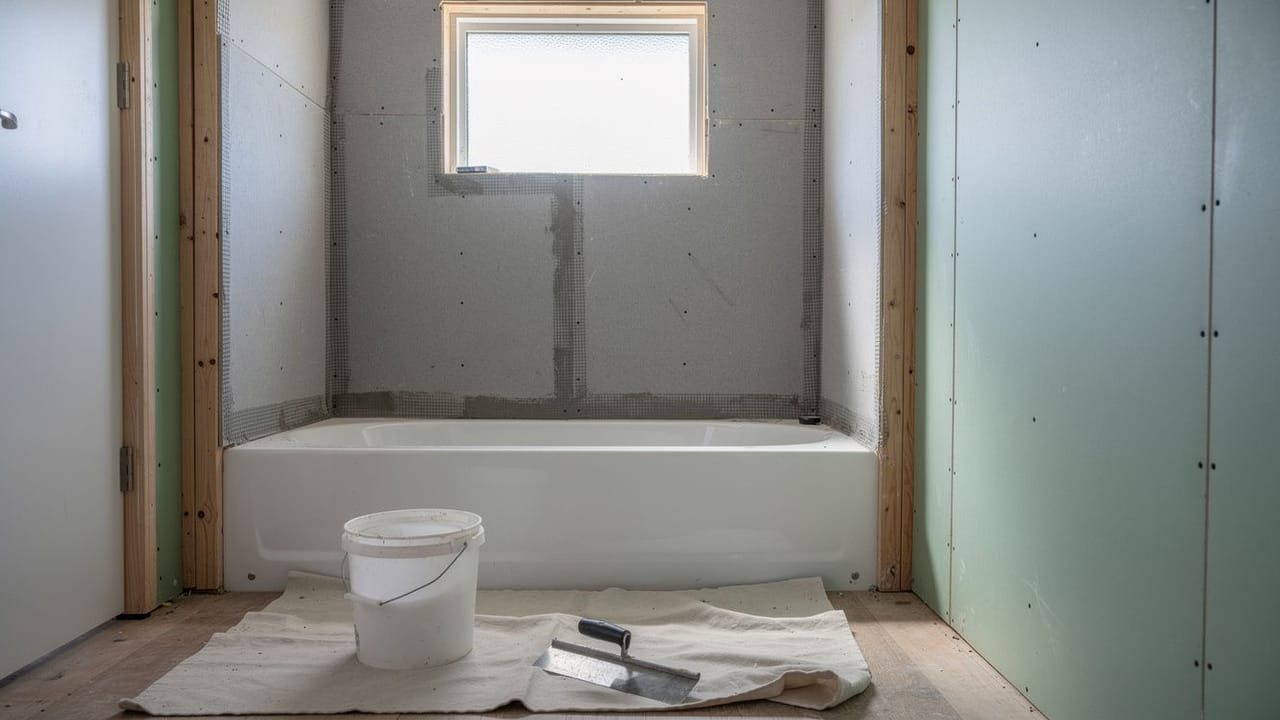
Standard board goes in ordinary rooms. Moisture-resistant board, the green-faced sheet most people call green board, goes on bathroom walls and ceilings outside the wet area; ASTM C1396, the specification for gypsum board, describes water-resistant backing board as designed mainly to be a base for ceramic or plastic tile on walls or ceilings. Inside showers and tub surrounds the backer has to be one of the products listed in Section R702.4.2 of the residential code as Tennessee adopted it: cement board, fiber-cement board, fiber-reinforced gypsum panel or glass-mat gypsum backing panel, each installed the way its manufacturer says. Foam backer boards are sold for showers as well, but they are not on that list, so we stay with the ones that are.
Paperless glass-mat board is the one that works on both sides of the shower curtain. ASTM C1178 covers a coated glass-mat water-resistant gypsum panel made for walls and ceilings in bath and shower areas as a base for tile, which is why it shows up on the code’s shower list. No board keeps mold away by itself, though, and the EPA’s guide to mold, moisture and your home starts from the same place we do: the key to mold control is moisture control. In a bathroom that means a fan that actually runs while the shower does, which is the EPA’s advice too.
Is green board waterproof?
It copes with damp air, not water running down it. Section R702.3.7.1 of that code says water-resistant gypsum backing board shall not be used where there will be direct exposure to water, or in areas subject to continuous high humidity. That puts it out of the shower and out of any room that stays steamy for hours at a time, whatever the stack at the supply house is labeled. Where green board does belong, Section R702.3.7 wants its cut and exposed edges, including those at wall intersections, sealed as the manufacturer recommends.
If we open an older shower wall and find green board behind the tile, we take it out and put a listed backer in its place rather than patch over it, then hang and finish the dry side of the room as part of our drywall installation work. The section numbers above come from the 2018 edition Tennessee adopted; Metro Nashville adopted the 2024 International Building Codes effective July 16, 2025, so a Davidson County permit may be reviewed under newer numbering.
- Standard board: ordinary rooms
- Moisture-resistant (green) board: bathroom walls and ceilings outside the wet area
- Cement, fiber-cement, fiber-reinforced gypsum or glass-mat backer: inside showers and tub surrounds
- Paperless glass-mat: on the code’s shower list, and our pick for the wall beside the shower
- Over and around the backer: whatever its manufacturer’s instructions call for
Basements
A finished Middle Tennessee basement sits against soil, so we treat moisture as the first question rather than the last. In basements we hang paperless board and keep its bottom edge off the slab, a habit that helps but does not make a wet basement dry. The EPA’s moisture tips go to the cause: keep indoor humidity below 60 percent, ideally between 30 and 50, and make sure the ground slopes away from the foundation so water does not collect around it.
If water is already getting in, fix the outside before anyone hangs a sheet. A finished wall hides the next leak, and the EPA warns that absorbent or porous materials may have to be thrown away once they go moldy. When a basement or bathroom wall has already been soaked, our water-damaged drywall service dries it out before rebuilding, and our post on repairing drywall after a leak walks through how we decide what stays.
Which ceiling board should I use?
Ceiling board depends on joist spacing and on whether a texture is going on. Under a water-based texture, the code’s note to Table R702.3.5 raises the minimum from 3/8 to half-inch board on framing 16 inches on center, and from half-inch to five-eighths on 24-inch framing, unless half-inch sag-resistant ceiling board is used, and it has the board run perpendicular to the framing. ASTM C1396 describes gypsum ceiling board as designed for interior ceilings with framing no more than 24 inches apart and a surface ready for water-based texture.
Texture and insulation are the loads the code has in mind: 3/8 board shall not be used on a ceiling that gets a water-based texture or carries insulation above it. USG’s environmental product declaration for its half-inch sag-resistant ceiling board says it supports sprayed textures and insulation better than five-eighths panels.
A ceiling dipping between the joists can come from the board, from fasteners that have let go, from water above it or from the framing itself, so we look before we price anything. Our ceiling repair page covers how sags are fixed, and if yours is dropping, you can book a free estimate.
Sources
- Tennessee Residential Code 2018 (IRC 2018 as adopted), Chapter 7 Wall Covering, Section R702, via UpCodes — R702.3.7.1 bars water-resistant backing board from direct water exposure and continuous high humidity; R702.3.7 edge sealing; R702.4.2 listed shower backers installed per manufacturer; R702.3.5 ceiling thickness, sag-resistant board, perpendicular application and the 3/8 in. limit
- Metro Nashville Codes, Metro adopts 2024 International Building Codes (2025) — BL2025-898 adopts the 2024 ICC codes, effective July 16, 2025
- ASTM C1396/C1396M-24, Standard Specification for Gypsum Board — Water-resistant backing board as a base for tile on walls or ceilings; ceiling board for framing up to 24 in. on center and water-based texture
- ASTM C1178/C1178M-18, Coated Glass Mat Water-Resistant Gypsum Backing Panel — Glass-mat panel for walls and ceilings in bath and shower areas as a base for tile (historical edition)
- US EPA, A Brief Guide to Mold, Moisture and Your Home — Moisture control is the key to mold control; run the bathroom fan; indoor humidity below 60 percent, ideally 30 to 50; ground sloping away from the foundation; porous materials may have to be discarded if moldy
- USG, Environmental Product Declaration, 1/2 in. Sheetrock UltraLight Sag-Resistant Interior Ceiling Board — Manufacturer’s claim that the board supports sprayed textures and insulation better than 5/8 in. panels
FAQ
Drywall Choices for Bathrooms and Basements — questions
Can I use green board in a shower?
No. The residential code says water-resistant gypsum backing board shall not be used where it will be directly exposed to water or in areas of continuous high humidity. Inside a shower or tub surround the backer is cement board, fiber-cement board, fiber-reinforced gypsum panel or glass-mat gypsum panel, installed to its manufacturer’s instructions, including any waterproofing those instructions call for.
What drywall is best for a basement?
We use paperless board in basements and keep it off the slab, but no board makes up for water getting in. Deal with the outside first: the EPA advises keeping indoor humidity below 60 percent and making sure the ground slopes away from the foundation. A finished wall hides the next leak, and porous materials that go moldy may have to be thrown away.
Why is my ceiling sagging between the joists?
It can be the board, the fasteners, water from above or the framing, so it is worth having someone look. On the board side, where a water-based texture goes on, the code calls for five-eighths board or half-inch sag-resistant ceiling board on joists 24 inches apart, and it bars 3/8 board from any ceiling carrying texture or insulation.
What is moisture-resistant drywall?
The green-faced gypsum board most people call green board, made to cope with damp air on bathroom walls and ceilings outside the wet area. ASTM C1396 describes water-resistant backing board as designed mainly as a base for ceramic or plastic tile, and the code wants its cut and exposed edges sealed as the manufacturer recommends.